A rainbow of color now fills the pages of my manuscript. Green for unnecessary adverbs, yellow for weak verbs, orange for clichés, pink for stated emotions, and red for absolutely unnecessary words or phrases. Colors splattered everywhere, like a Jackson Pollock painting.
With my first draft written, it’s time to brutalize my work. Mark it up with pen strokes, highlights, sticky notes, and symbols that tend to make sense only to me, a secret code to signal to my brain what needs to be fixed. It brings to mind the markings done by a plastic surgeon -a tummy tuck and eye lift for the page.
To help me with this endeavour, the newest read in my stack of 20+ current reads is Good Writing: 36 Ways to Improve Your Sentences. Honestly, just the first three rules would have been enough to create a world of change to my novel. My biggest culprit has been weak verbs, such as “walked,” “felt,” “looked,” “kept,” “moved,” “made,” etc.
But the most egregious word turned out to be “just,” an adverb used 174 times in the 50,000-word chunk I’m focusing on. Manually highlighting that word so many times has placed it within the tiny corner of hatred I hold in my heart. Perhaps going forward, I won’t find them shotgun-blasted all over my manuscripts.
Despite all this, I enjoy reaching the revision phase of my writing process. It’s like putting together a complicated jigsaw puzzle or solving an escape room. Writing the first draft with wild abandon is thrilling and fun, but true fulfillment in my writing comes from sculpting the lump of words into a detailed shape.
Usually when I start the revision phase, I’m not entirely sure what shape my novel will inevitably take. But even if I did, the final product will never appear as intended. And that’s what makes it an exciting adventure.
Yes, you’re carving and sculpting. But you’re also discovering. Though I have a general idea, I cannot fully conceptualize what my finished manuscript will look like. All I can see right now is this:
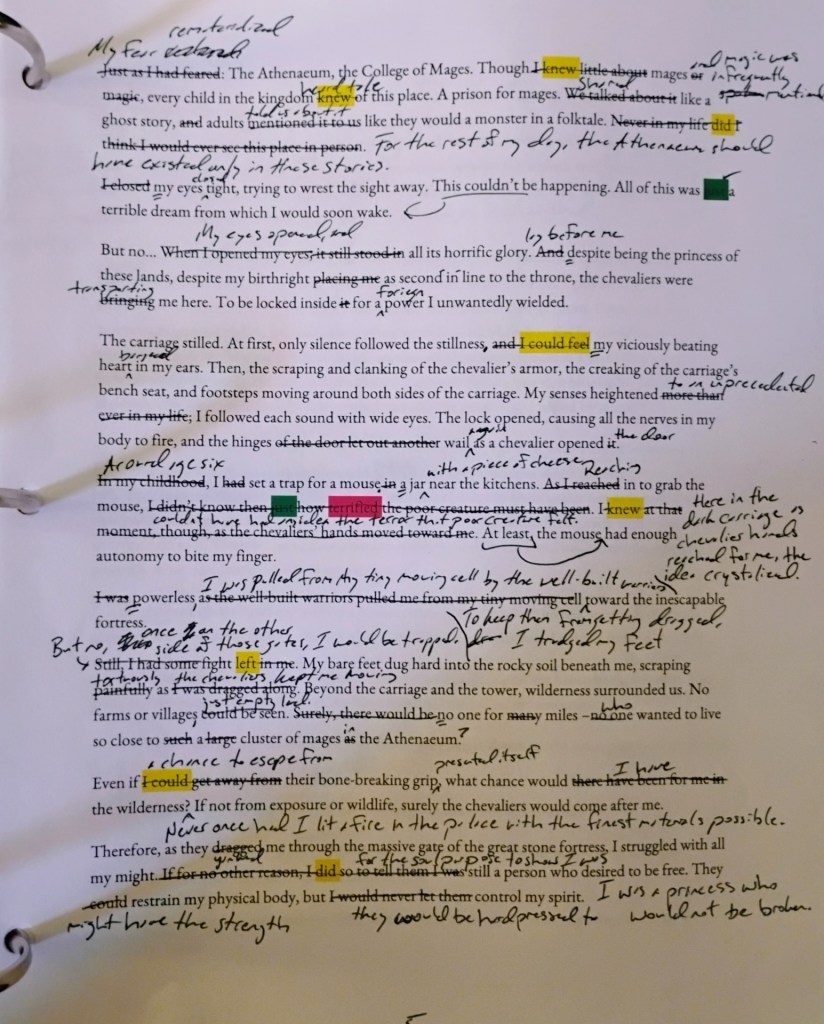
And I know this probably shocks, terrifies, or overwhelms some people to see. But for me, this is a thing of beauty.
Just as I have no idea the type of person my daughter will be when she’s grown, despite understanding her as she is now better than anyone, so too with this novel and all the novels I will write in the future. For both, all I can do is my best, to learn all I can and apply it wherever I can, while still allowing them to be what they are destined to become.
Granted, I will be far kinder and more understanding to my daughter than I ever will be to my written work.
 C. Sloan Lewis
Leave a comment