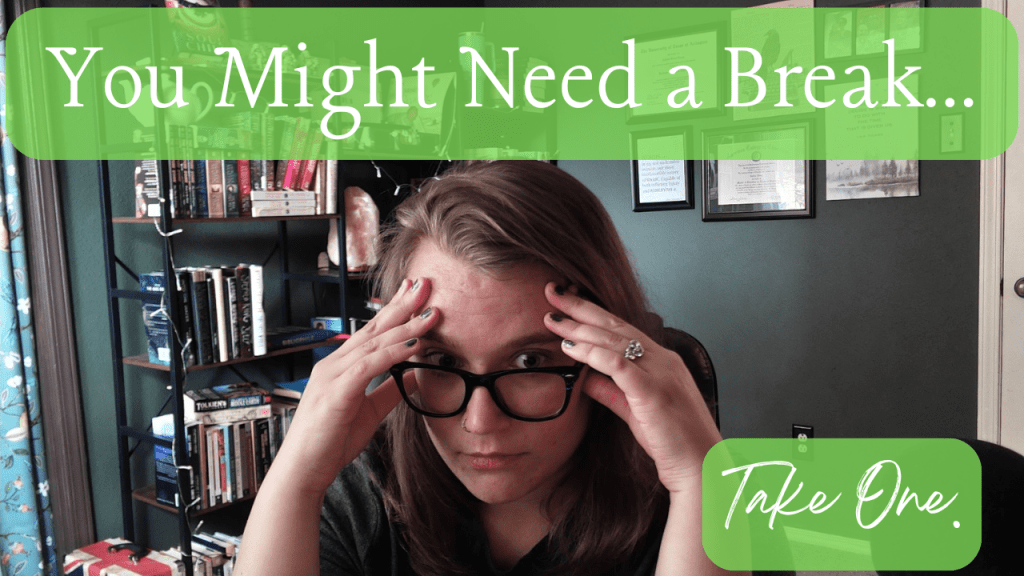
Transcript:
Now, here me out, what if I told you that resting is part of the writing process? That pausing your novel, your blog, your poetry… doesn’t mean you’re failing as a writer. It means you’re human.
Hi, I’m C. Sloan Lewis, your virtual writing coach, and in honor of Mental Health Awareness Month, I want to talk about something most writers wrestle with but rarely give themselves permission to do:
Taking a break.
Today, we’re going to unpack why breaks are not only healthy—but essential—and how choosing rest might actually be the best thing you can do for your creativity and mental health.
Welcome to my channel!
The Myth of Constant Productivity
We’ve all heard the advice: Real writers write every day.
And if you don’t—what? You’re not serious? You’re lazy? You’ve lost your “muse”?
There’s this toxic idea in writing culture —and really in most artistic cultures— that if you’re not constantly producing, you’re falling behind. Add in social media—where everyone’s sharing word counts, book deals, and “day in the life of a writer” reels—and it’s easy to feel like rest equals failure.
But here’s the truth: writing is a deeply creative, emotional process. And creativity doesn’t thrive under constant pressure.
Maya Angelou once said, “You can’t use up creativity. The more you use, the more you have.”
I completely agree—but not if you’re exhausted.
Why Breaks Matter
So, why do breaks matter?
From a science perspective, rest allows your brain to process complex ideas in the background. This is called diffuse thinking—and it’s why we get so many “aha!” moments in the shower or on a walk.
Rest lets your subconscious untangle plot holes, character arcs, and those pesky sentences that just won’t cooperate.
When you step away, you’re not quitting—you’re creating space for clarity.
When you pause, you allow room for growth, reflection, and deeper insight.
Writers aren’t machines. We’re artists. And every artist needs time to step back and breathe.
Signs You Might Need a Break
Sometimes, we push through for so long we don’t even realize we need a break.
Here are a few signs it might be time to step back:
- You dread your writing time—what once lit you up now feels heavy.
- You find yourself stuck in constant self-doubt.
- You’re exhausted, mentally foggy, unable to focus.
- You start to think: “Maybe I’m not cut out for this.”
This isn’t failure talking. That’s fatigue. And you deserve to take some time for self-care.
How to Take a Healthy Break
Okay—so you’ve decided to take a break. But how do you do that without spiraling into guilt?
Here are some tips for taking a healthy, intentional break:
- Set a check-in point. Give yourself permission to pause for a day, a week, or a month—and decide when you’ll re-evaluate.
When I was working through my certification program to become a writing coach, I gave myself a full month of rest both from my program and from writing because I had been flying around like a mad little worker bee for several months straight. I was tired, and I needed that month. Then, at the end of it, I got back to work, stronger and more productive than I would have been otherwise.
2. Journal through your thoughts. You’re not abandoning your story. You’re giving it—and yourself—room to breathe.
Sometimes its really helpful to give yourself a few minutes before any writing session to just journal out all your thoughts, especially ones that might keep you a little too grounded in reality.
3. Stay gently connected to creativity. Read a book. Sketch. Bake. Listen to music. Doing some form of creative rest refills your well. Heck, sometimes I take a page from my toddler’s coloring book and color a unicorn. It doesn’t have to, and probably shouldn’t, be anything substantial.
4. Create a “Creative Sabbath.” One day a week with no pressure to produce—just be. Even god needed to take a day after being super creative. Sure, it was like the whole world or whatever, but you get my meaning.
If nothing else, remember that rest isn’t the enemy of progress. It’s what allows progress to happen.
The Fear of Losing Momentum
Now, I know what some of you are thinking:
“If I stop, what if I never start again?”
That’s a very real fear. But here’s the good news: when you rest with intention, the desire to write does come back.
Often stronger. Often clearer.
Personally, I’ve taken breaks when I felt totally burned out—and each time, I returned with more energy, better ideas, and a deeper love for the craft.
But if you burn out so badly, that you’re basically forced to take a break. Chances are, yeah, you’re not going to return to something that almost broke your brain.
You are not a machine. You are a storyteller. And even stories need silence between the words.
Giving Yourself Permission
So if you’re watching this and you’re tired—if your heart’s been heavy and your pages are blank—let me say this directly to you:
You have permission to rest.
You are still a writer, even when you’re not writing.
Breaks are not signs of weakness. They are acts of strength.
In fact, choosing to care for yourself—mind, body, and soul—is the most writerly thing you can do. Don’t let all those images of writers hunched over a typewriter, smokin’ a cigarette make you believe otherwise.
Outro
I hope this video gives you the courage to pause, to breathe, and to know that your words will still be there when you return.
Tell me in the comments: Have you ever taken a writing break? What did it teach you?
Don’t forget to like this video, subscribe if you haven’t already, and share it with a fellow writer who might need to hear this.
Next week, I’ll be talking about mental health while query trenches. But until then, you’ve got some writing to do —or perhaps a bit of resting, so I’ll see you in the next video. Ta-ta!
 C. Sloan Lewis | Your Virtual Writing Coach
Leave a comment