
Transcript:
Has anyone else noticed how most writing advice is geared toward the negative? Posts and videos like “Fix Bad Writing” and “Why Your Characters SUCK” (the word suck almost always in all caps for some reason…). They paint this picture that if you aren’t writing in the exact way the writing advice suggests, then you are doing something wrong.
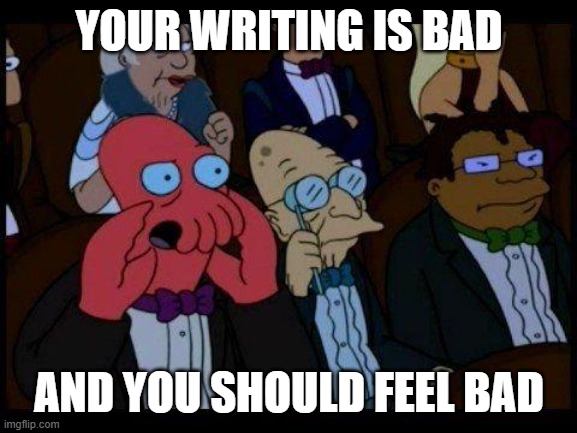
I think this method of giving writing advice is pretty toxic, especially when the person giving the advice is actively trying to tear down the writer, to make them feel like something seriously needs fixing. You know, like how Special K made everyone feel fat in the early 2000s to sell their terrible cereal.
This idea is so toxic because writing in any form is never bad, never something to be ashamed about. The fact that you have written something, anything, is inherently good, an accomplishment even.
Are there ways to improve your writing to make it clearer, more engaging, and closer to your vision? Absolutely! In fact, I can guarantee you that you’ll never reach perfection in your writing, which is actually a good thing.
So today, I want to fight back against these negative ideas and help you to see that your writing is never something to feel bad about, even if there’s a lot you could improve upon.
Hi I’m C. Sloan Lewis, your virtual writing coach, and my goal is to help you not just improve your writing—but to support you as a writer. Welcome to my channel!
The Psychology of Hating Your Own Writing
Have you ever looked at your writing and thought, “Ugh, this sucks,” and then self-reflected on why you believe that? We do the first part of this all the time —it’s the writer’s curse, especially when going back to older writing. But I doubt many of us self-reflect on where that idea is coming from.
While the “comparison trap” is now a term used almost specifically for comparing yourself to others on social media, this has always been a problem for writers. Instead of a woman with perfect hair drinking cocktails on a white sandy beach, the writer has always had a bookshelf full of novels nearly perfectly revised and edited next to their writing desk.
Looking from their writing to the works of their favorite authors, writers have always had that dreadful question of “why can’t I get my writing to look like this?”
But on top of this age-old curse, we now have countless writing advice blogs, videos, workshops, and webinars that seek to tear apart the writer in the hopes of rebuilding them into something new. The trouble is… the negative feedback often leaves writers so discouraged that they get writer’s block (at best) or quit writing altogether (at worst). Many of these negative advice givers might argue that they weren’t cut out to be writers then, or that this is just part of the process of becoming great.
I strongly disagree.
I do want to acknowledge, though, that there are many advice givers out there who don’t realize the harm they’re doing. More than anything, they know it’s gonna get the clicks, it’s gonna get the likes. People seem to enjoy the content.
But I think most of the clicks are motivated by the impostor syndrome of the writer. Am I doing those things? If I don’t follow their advice, will my story really SUCK? I have to fix this before anyone finds out I’m a terrible writer.
Due to how personal writing is to the writer, it is so easy for us to fall into impostor syndrome. And these negative posts about writing are preying on those insecurities.
You may ask: What if some people need the negativity? What if it drives them forward?
I’ve seen so many people in my life strive for something with negative feelings being their main source of fuel. Hating your body to lose weight, calling yourself a lazy slob to work harder, or saying that your completed projects are garbage to perform better next time. All of it leads to burnout. Sure, you might accomplish the thing you set out to do, but what’s left of you when you get there?
In most of these instances, we’re being led to believe something that is not entirely, or at all, true. These are biases that the comparison trap or impostor syndrome has led us to believe. You aren’t unlovable if you’re fat, you don’t need that promotion to feel fulfilled, and your writing isn’t something you should be ashamed of.
Why Writing is Always Worth Celebrating
Honestly, I don’t think we give as much acknowledgement to the accomplishments of writers as we should. It’s reached the point that writers don’t seem to deserve praise until the book has been published and is on the shelves of Barnes and Noble.
I don’t know if you’ve noticed, but hard work and talent are not the greatest indicators of a published or even best-selling book. Twilight, Fifty Shades of Grey, The Da Vinci Code, City of Bones… none of those books are great pieces of literature. It’s fine that people enjoy them, but these books were successful not because the writing was good. The allure of the taboo, an easy-to-follow mystery, and market trends are what made those bestsellers successful.
If the only point in writing were to publish a best seller, then I would understand how we came to establish it as “good writing.” But I think we as a community of writers need to dig a little deeper.
The first thing to understand is that writing is a craft. To go from idea to completed manuscript is such a feat with so many moving parts. So what if your draft is messy? You just wrote a whole book and should celebrate that. Creating something out of nothing is an achievement, full stop.
But I think we need to dig even deeper than a completed novel. For instance, have you ever had to scrap a paragraph, scene, chapter, or even an entire project only to feel like the time spent on your writing was wasted? It wasn’t —no matter how strongly you feel like it was. Every single word you write goes toward the practice of developing your craft. Over the scope of a writer’s career, they are going to scrap way more of their writing than they publish. If I had to make a rough estimate, I would say at least 100 times more writing gets scraped than put on a shelf.
Scraping a part of your writing or a whole project (both of which I’ve done many times) doesn’t mean you are doing anything wrong. In fact, your ability to know when something isn’t working proves that you know what you’re doing.
This is why its important for us to self-reflect, to see how far we’ve come in our writing journey. And a big piece of what these negative-leaning pieces of advice don’t tell you is that there will always be something for us to reach for to grow as a writer. You need to celebrate the small wins to keep yourself from quitting the game altogether.
What to Do When You Hate Your Own Writing
But maybe the damage has already been done. Whether you are looking back on your old writing or sitting in front of a blank page, you feel dread, despair, or even hatred toward your own writing. Writing has become confusing, painful, and downright depressing. Let’s talk about how we can work through these feelings and return to our writing with acceptance and possibly even love.
Firstly, I would suggest that you take a break. A week or two of self-care does wonders for the creative soul. And even if you are not yet to the point of hating your writing, I would still suggest you take self-care breaks from time to time. Additionally, spending time away from your writing allows you to get clarity over what you want from your writing and the story you’re currently trying to tell. We can get hung up on all the rules and structures that we actually lose the thread of what we were trying to say with our writing in the first place.
Once you’re ready to return to your writing, read through it with purpose. Don’t just look for what’s wrong with it, look for what’s working. As you go through it, set down the red pen and pull out a highlighter to mark lines you like, strong images, and compelling character moments. Ask yourself what you would like to see more of in your writing with the aspects you’re already doing well with.
Then, when we do pick the red pen back up, stick to constructive notes and questions. Don’t just say, “this entire scene sucks.” That’s super vague and doesn’t provide you with any direction. You’ll just get stuck in the mud of your despair. Instead, ask yourself, “What do I wish this scene was doing?” or “What is one area (such as description, dialogue, or pacing) I can work to improve on?” Just like you wouldn’t tell a friend their writing sucks, don’t do it to yourself. You deserve better.
Lastly, find some safe readers to show your work to. You can’t just stare at it on your own forever. Find a critique partner or enlist your friend or spouse. There are days I sit down with my critique partner and tell her I’m feeling a little fragile about my writing, so she knows to highlight more of what is working and just give me one or two areas for growth in the chapter she read.
For all of these steps, it is important to give yourself time and grace. Your healing from the negativity and rewiring your brain to think more compassionately about your writing and yourself as a writer.
Reframe Progress: You’re Not Failing—You’re Growing
It’s important to keep in mind that every writer, even the most successful ones, writes cringey prose, many of them having learned the rules of writing the hard way. Some writers are even able to successfully publish cringey writing. I’m not going to call anyone else out, but I know you have a book in mind that supports this idea.
So if you’re staring at your writing and feeling that creeping dread, I want you to remember this: you are not failing—you are growing. Writing is not a test you pass or fail. It’s a skill you build, a muscle you strengthen, and a form of self-expression that no one else can do quite like you.
The world doesn’t need more perfect writing. It needs more real voices—yours included.
Outro
I hope this video gave you a new way to think about your writing and a little more grace for where you are right now. And if you’re looking for a space that values growth over shame, craft over clicks, and celebration over self-doubt—you’re in the right place.
I’m C. Sloan Lewis, your virtual writing coach, and I’ll be here every week to help you strengthen your writing and your mindset. If that sounds like something you need more of in your writing life, go ahead and hit subscribe and stick around. You deserve support on this journey. We all do.
You’ve got some writing to do, so I’ll see you next week. Ta-ta!
 C. Sloan Lewis | Your Virtual Writing Coach
Leave a comment