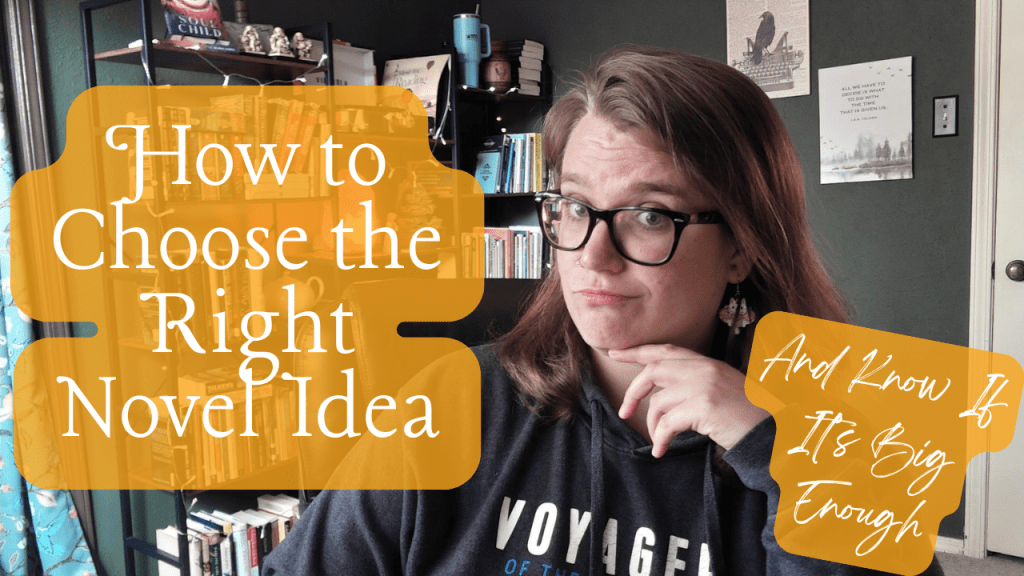
Transcript:
Do you have too many story ideas and no clue which one to commit to? You’re definitely not alone. In fact, I received several comments and messages from my video “Turn Your Idea into a Novel” about what the heck you’re supposed to do if you have no clue which of your copious ideas you should pick.
In that other video, I broke down the three steps to turning an idea into a novel: define your core concept, create a roadmap, and dedicate yourself to writing it. But even just those first two steps can take a long time, and if you have a dozen or more ideas to pick from… that’s going to take way too long.
But don’t you worry, I’ve got you covered. We’re going to go over all the ways to narrow down those ideas, and I’ll be giving you tools on how to identify which ideas are great for novel writing and which will need to be set aside.
And if my instructions in this video seem like a lot, don’t worry. It will take less and less time and you’ll develop better intuition of what makes for a solid novel idea with practice.
Hi I’m C. Sloan Lewis, your virtual writing coach, and my goal is to help you not just improve your writing—but to support you as a writer. Welcome to my channel!
Step 1: Find the Idea That Excites You Most
Whichever idea you pick, you need to ensure that it’s the one you feel the most passionate about. When the going gets tough (and it will), that passion is going to keep you moving forward. But that’s not to say if you lose your passion for an idea halfway through the long, arduous writing process you should toss it and grab another idea. There will be times for love and times for hate, but it’s more likely that ideas you’re just meh about at the beginning will turn into absolute loathing during the drafting and revision stages.
But pointing to the idea that you’re most passionate about is easier said than done. Ask yourself the following questions to help you with this:
- Which idea keeps popping into your head?
In the shower, on your way to and from work, while doing the dishes, what’s the book idea you think about most?
I knew I needed to sit down and write The Soul Child when I couldn’t stop thinking about a snarky female wizard standing up to a conceded and annoyingly handsome warlock. I had to write their story, even though I had countless other ideas bouncing around in my head at the same time.
- Which one would you be excited to talk about for hours?
Have you ever had an idea that you were so excited about that you had to take a deep breath and go, “Okay, so…” before jumping in? Maybe you wouldn’t talk about this idea with just anybody, especially one not fully formed, but what about your best friend, your mom, or your spouse? If you have an idea burning in you that you want to share, that’s a pretty darn good sign.
- Which one sparks scenes, characters, or themes in your mind?
If you can imagine the characters, locations, or even the message you want to get across to your reader, you’re already past just the idea stage, whether you realize it or not. It might not be down on paper yet, but you’ve already started brainstorming and outlining.
So take these three questions and jot down your answers in a few minutes. This should be short to allow the most important ideas to jump to the surface. Don’t think about it too much, just write what comes to your head first, even and perhaps especially if it surprises you.
Step 2: Test the Depth of the Idea
It’s important to know that not every idea is going to be deep enough to span the entirety of a novel. However, that doesn’t mean it couldn’t turn into a short story or even a scene in a novel you create out of a different idea. On the flip side, also keep in mind that an idea can also span far more than a novel and you don’t want to make a plan for one novel that should instead be three.
For instance, I have this overall idea that I came to call The War of the Five Queens. I thought it would just be a single book, but after breaking it down, I realized that I would need a book for each of the five queens. The first book for this is in early, early development right now, and probably won’t see the light of day for years so I can focus on some shorter projects first.
So, can your idea carry a full novel? Here are more questions to ask yourself, so get your pen ready:
- Does your idea have a central conflict that could sustain 50,000+ words?
While you don’t need to go into extreme detail here, it’s important to have a strong understanding of the external conflict of the plot and the internal conflict of the protagonist. These things have to be challenging, something that might take a lot of trial and error. Additionally, you need to understand what the characters might lose if they don’t overcome the challenges facing them.
I have a story I’ve been developing where the character has to traverse a dangerous post-apocalyptic world (external conflict) and forgive herself of her past (internal conflict) if she is ever to see her five-year-old daughter again. The stakes are high for my protagonist to overcome her conflicts.
- Does the main character have room to change and grow?
Basically, does your character have a fatal flaw? This is usually wrapped up directly with the protagonist’s internal conflict or even the cause of the conflict.
- Can you imagine subplots, twists, and layers beyond the main idea?
Again, you don’t have to do a ton of planning here, but if your idea is super simple like “a girl finds out she can talk to ghosts” you’re gonna have to dig into that idea a bit to figure out if it’s viable for an entire novel.
So you can sit down and answer these questions like the last ones, and/or you can try the “What if?” test—expand your idea by asking “What if?” five times. For example:
What if the girl can only talk to the ghosts of people she’s met in real life?
What if she can only talk to the ghosts of animals?
Just write down any interesting questions that pop into your head to see what potential the idea has.
Step 3: Consider the Longevity & Market Fit
If no one has told you yet, writing a novel is a long process. It can span anywhere from six months to ten years, but let’s just say six months to a year. Even so, that’s a long time. A lot happens in a year, and you need to be sure about this idea before you commit to it, right?
So let’s do the longevity check. Write down your idea in a notebook or on a sticky note where you will see it every day. After two or three weeks, ask yourself “Do I still love this idea?” and “Does it have themes and/or emotions that still deeply resonate with me?”
Sometimes we can get ideas during emotionally high or low times, but those might not fit our natural state. You don’t want to write a whole novel around an idea that once enraged you if you’re more like, “I mean, I’m not a fan…” shrugs
Lastly, let’s talk about Market & Genre Fit. I don’t see this as an entirely necessary step, so you can skip it if you want, but I know there are writers who this will help, so let’s get into it.
First off, you need to determine what genre this idea might fit into and ask yourself whether this fits within the genres you typically enjoy reading and writing. If you really enjoy epic fantasy but set out to write a romantasy, you might get a little tripped up between those genres. Or if you set out to write sci-fi but you actually find reading sci-fi quite boring, then you’re going to have a hard time.
Then, you need to look at the market trends, especially if you are hoping to get this novel traditionally published. This is a delicate balancing act between aligning with market trends but also not writing a novel with trends that are oversaturated. If you are just now setting out to write a romantasy about fairies or dragons, I’ve got some bad news for you. Look at what has only just started to become popular, not what’s been popular for a couple of years or more.
Gut Check
Before you jump into an idea or toss it aside, it’s always good to do one final gut check. Take a moment, close your eyes if you need to, and ask yourself—if you had to spend the next year working on this book, would you be excited or bored?
Our guts are much smarter about these things than we give them credit for.
Outro
Unfortunately, there are no easy answers when it comes to choosing which idea is best for a novel, but I hope these strategies will help you in deciding. If nothing else, just pick an idea and give it a go! Time spent writing, even if the project is scraped, is never wasted time.
But that’s all from me today. Don’t forget to like and subscribe for more videos. You’ve got some writing to do, so I’ll see you next week! Ta-ta!
 C. Sloan Lewis | Your Virtual Writing Coach
Leave a comment