
Even though we learn to talk well before we learn to write, writing dialogue can prove to be quite a challenge for many writers. If you’ve spent most of your life writing academically or professionally and are just now diving into creative writing and storytelling, dialogue can often feel impossible to master. But don’t worry, I am here to help you write dialogue that is both authentic and fun to write.
Between writing narration and dialogue, I much prefer the latter because it is such an excellent and entertaining way to show characterization, build relationship between your characters, and reveal backstory. And as we’ve seen recently on TikTok, some only like to read the dialogue, making it that much more important! (only joking…)
One of my favorite examples of strong dialogue comes from the opening of Pride and Prejudice by Jane Austen:
“My dear Mr. Bennet,” said his lady to him one day, “have you heard that Netherfield Park is let at last?”
Mr. Bennet replied that he had not.
“But it is,” returned she; “for Mrs. Long has just been here, and she told me all about it.” Mr. Bennet made no answer.
“Do you not want to know who has taken it?” cried his wife impatiently.
“You want to tell me, and I have no objection to hearing it.”
This was invitation enough.
“Why, my dear, you must know, Mrs. Long says that Netherfield is taken by a young man of large fortune from the north of England; that he came down on Monday in a chaise and four to see the place, and was so much delighted with it, that he agreed with Mr. Morris immediately; that he is to take possession before Michaelmas, and some of his servants are to be in the house by the end of next week.”
From just these eight lines, we learn about Mr. and Mrs. Bennet (Lizzie Bennet’s parents and the guiding forces behind her choices throughout the novel), exposition, and the inciting incident. There is so much dialogue can do for us as storytellers, so let’s get into the weeds, shall we?
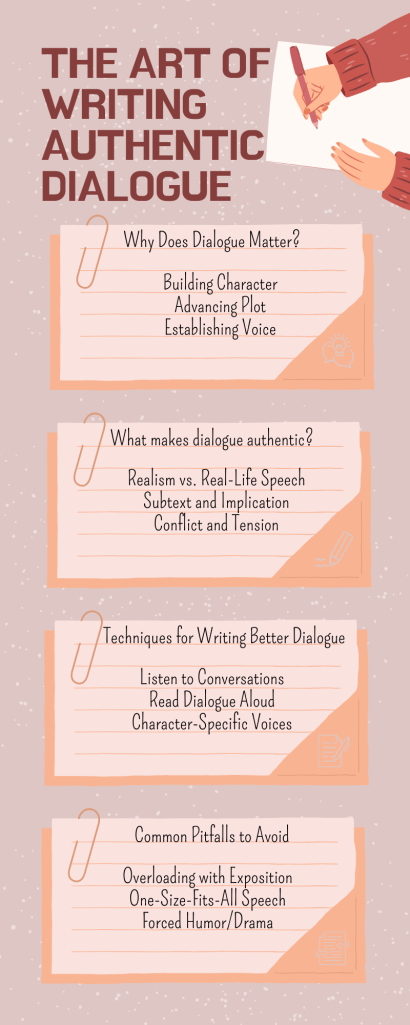
Why Does Dialogue Matter?
Dialogue does three main jobs for us, which break down into a lot of moving parts: building character, advancing plot, and establishing voices.
- Building Character: Effective dialogue will reveal a characters personality, backstory, and aspects of their relationship with whoever they are talking to.
- Advancing Plot: It will also move the story forward
- Establishing Voice: Showing what the character shows like through distinct speech patters instead of telling us.
We see all three of these parts clearly in the Pride and Prejudice example above. It builds the characters of Mrs. Bennet (an excitable, gossiping, overbearing mother who is desperate for her daughters -or at least the eldest daughters- to find rich, respectable husbands. In contrast, we learn that Mr. Bennet doesn’t care much about the goings-on of their community and loves to tease his wife who does. Later dialogue reveals that, while he doesn’t care about this stuff, he cares about his wife enough to support her desires.
The plot also advances because we learn about the inciting incident that leads Elizabeth Bennet and her sisters into the series of events that make up the story. Information being revealed or a decision being made between two or more people are just a couple of ways dialogue serves to move the plot forward.
While dialogue has characters literally using their voice, it can be a challenge to establish what their voice sounds like without using a lot of adverbs. There are a lot of great techniques into making a characters dialogue not only feel real but provide insights for the reader about their background and personality. We’ll be getting into these techniques below.
What makes dialogue authentic?
While the world authentic might sounds like the dialogue has to be true to real life, that’s not quite what were going for here. Just think about the last time you met up with someone. There’s a lot of things you said at the beginning and end of the conversation (and probably in the middle, too) that was just fluff to get the real conversation started.
“Hey! How’s it going?”
“Good! How are you doing?”
“Oh, just fine. How are the kids?”
“They’re awesome.”
No one wants to read that stuff. It’s like the part in Monty Python and the Holy Grail when all the characters start screaming, “Get on with it!” You only want to write out the dialogue that has substance. To do that, you need to consider the following three concepts:
- Realism vs. Real-Life Speech: Striking a balance between natural flow and narrative purpose.
- Subtext and Implication: How what’s left unsaid can carry meaning.
- Conflict and Tension: Making dialogue dynamic and engaging.
Just like with the above example, there are a lot of aspects of our speaking patterns in conversation that we just don’t need in our writing. At the same time, though, you want to make what is said, unsaid, and how the characters react to both to be as real as possible. If it helps, you can start by writing out the conversation as true to how it would be said in real life then find all the parts that are not crucial to the story and either take them out or tell the reader and move on. Instead of those four lines of dialogue, you could simply write, “They greeted each other.”
One big part about writing authentic dialogue that I didn’t learn in any of my creative writing courses in high school and college is what’s left unsaid. Not only can characters imply or use euphemisms to express ideas to the person that they are talking to, but they can also avoid saying certain things, which can greatly inform their character and their relationship with whomever they are speaking with. We experience this sort of thing all the time in our own conversations. You are going to express yourself much differently between your best friend and your mother-in-law. It’s the same for our characters.
Cutting out all the necessary bits and leaning into the subtext and implications is naturally going to make your dialogue stronger in conflict and tension. When it comes to making dialogue more dynamic and engaging, you also need to ask yourself the question of “why is this conversation important?” It has to be important. If it’s not, cut it out or replace it with a brief summary (telling).
Techniques for Writing Better Dialogue
- Listening to Conversations: An age old, tried and true method for getting better at dialogue is to listen to real conversations. Yes, I want you to eavesdrop on other people. You can go to a coffee shop, restaurant, museum, or wherever else people have conversations. Don’t be weird about it – no staring or slowly inching closer to them. But this really helps because we are usually engaged in conversations as a participate, so we might not be able to really think about the words being said, especially if your a bad listener.
- Reading Dialogue Aloud: What better way to figure out if something sounds like it would be spoken aloud than speaking it out loud? The parts of our brain that read versus speak differ. You might read a passage and think it sounds fine, but when you read it out loud it sounds odd. It might be too proper or academic. It might sound like something a Texan would say rather than a Brit. Or you might even notice that it reveals too much about a character/ isn’t something the character would say. Whatever the case, you’re far more likely to notice these things when you read it aloud.
- Character-Specific Voices: Each character’s personality and perspective should come through in their dialogue. You can practice this by writing a line of reaction to an event. Let’s say four different characters see a tree spontaneously combust. Here’s how different personalities may react:
- Curious: “How on earth did that happen?”
- Scared: “Run! We’re all gonna die!”
- Optimistic: “Wow. That was really cool!”
- Logical: “I’m sure there’s a perfectly good explanation for this.”
Playing games like Dragon Age, Mass Effect, or KOTOR can give you great insight into how personality affects what you say. I’ll be getting into in my post about video games and what they can teach us about writing.
Common Pitfalls to Avoid
To end this post, I wanted to discuss the ways we tend to actively make dialogue worse:
Overloading with Exposition: Avoiding unnatural info dumps.
While dialogue can allow us to provide exposition/background to readers, we want to make sure to do it both sparingly and realistically. Think of this way: if two of your characters know the situation or the history of each other, they wouldn’t tell each other about it. They already know, and the only reason it is being written is for the reader, but these characters aren’t speaking for the reader (not really).
Instead of a character telling his sister: “You know our mother. She is a tough woman who would never let something like that happen. She single-handedly defeated that army.” It would honestly make more sense for the character just to say: “You know our mother.” All of the other stuff is implied with what he says in that single sentence.
What if the character doesn’t know that stuff, though? That’s when you ask whether or not it is the right time or place for the character to provide that information. You wouldn’t reveal a big secret to someone you just met or in a crowded room, so you need to give your characters that same level of discretion.
One-Size-Fits-All Speech: How generic dialogue can flatten characters.
This tip is just another way to explain how and why to give your characters distinct voices. If everyone sounds the same, not only can it confuse and/or bore the reader, but it also keeps you from adding life into your characters. It doesn’t have to be anything too complicated.
For instance, in one novel, I have a serious mentor-figure never use contractions in his speech and a character with an accent similar to Irish and they always use “ya” and “yer”. Just those subtle differences make it clear to the reader who is speaking and what they sound like without dialogue tags or adverbs (though, I do enjoy the occasional adverb).
Forced Humor or Drama: Recognizing when dialogue feels contrived.
It can be tricky to get a handle on dialogue sounding genuine. The big key is to stay true to the character, remembering that they are a real person for the purpose of your story. Obviously, everything we write is made up, so we intend for things to sound funny or dramatic or some other tone. But forcing a character to say a joke or react dramatically when it doesn’t fit their character is an immediate ick to the reader.
Just let the humor and drama flow naturally from the cause and effect between your characters and plot points. Of course, as you revise, you can always find ways to enhance the language and make it lean into the humor or drama.
Conclusion
Writing dialogue may seem daunting at first, but with practice and attention to detail, it can become one of the most enjoyable parts of storytelling. Remember, the goal is not to mirror real-life conversations but to create exchanges that feel authentic, advance your story, and reveal the depth of your characters.
By focusing on realism without the fluff, leaning into subtext, and crafting distinct voices for your characters, you’ll elevate your dialogue from ordinary to unforgettable. Most importantly, don’t shy away from revisiting and revising your work—great dialogue often emerges during the editing process.
So, the next time you’re struggling with a scene, take a step back, read the lines out loud, and ask yourself: does this sound like my character, and does it matter to the story? If the answer is no, you’ve got some trimming to do. If yes, congratulations! You’re one step closer to mastering the art of dialogue.
 C. Sloan Lewis | Your Virtual Writing Coach
Leave a comment