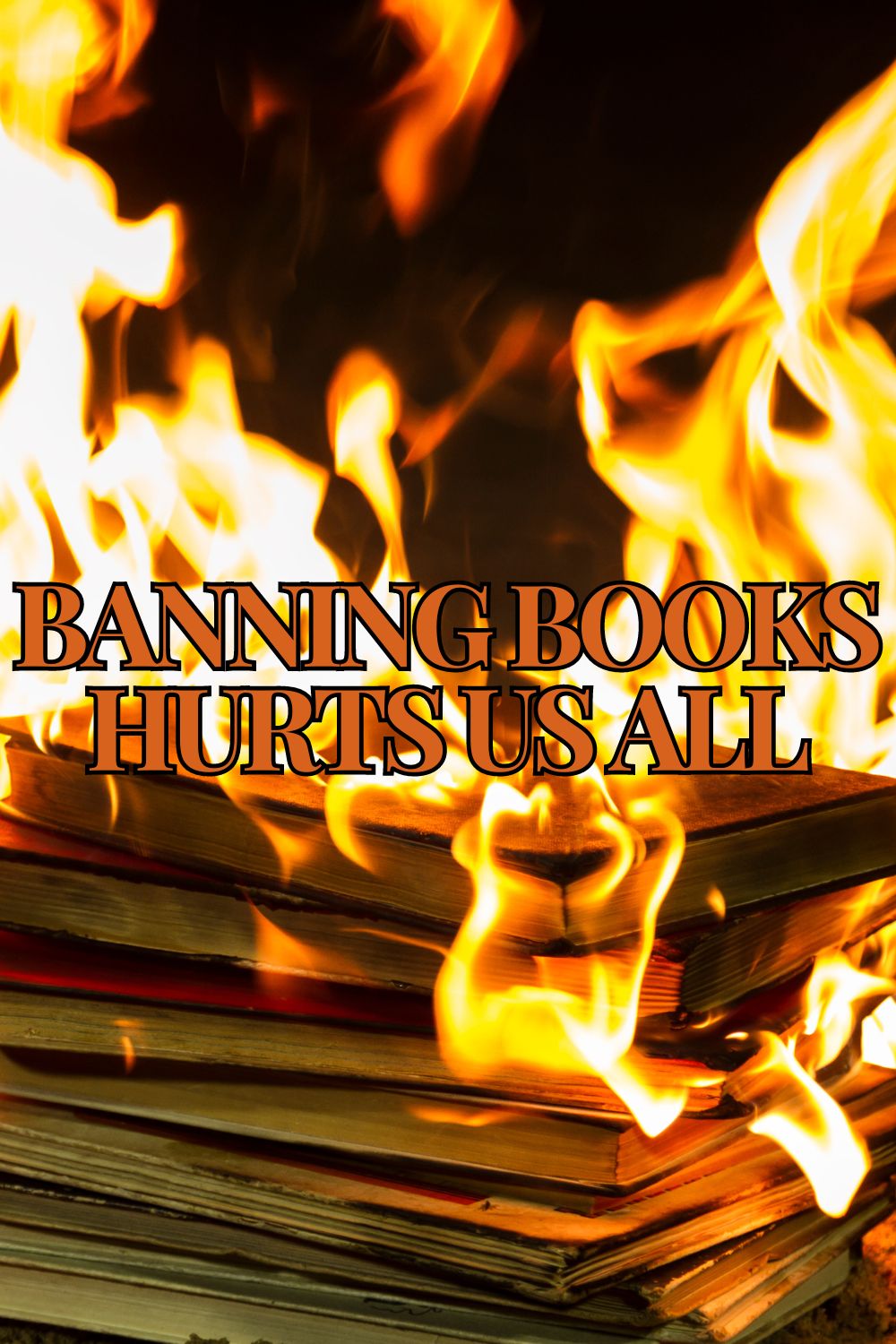
At the end of September, most libraries and English teachers will be celebrating Banned Book Week, a time of the year to raise awareness of the harmful nature of banning books. As an English teacher in Texas, which banned over 4,000 books last year, this is a cause I feel really strongly about. Everything’s bigger in Texas, especially our collective ignorance.
Censorship is nothing new in our society. What is new is people thinking censorship is no longer a problem while it grows and festers across America. Now, I am a proud Texan and a proud American, but boy howdy do I disagree with those who attack our first amendment rights.
Now, I’m not gonna get all political. There’s too much of that going on with the election coming up. Instead, we’re sticking to the topics I know best: history and literature.
Let’s go back in time to 1933, back to a time when the Nazi party was ramping up and German nationalism was at a devastating high point. On May 10th, 1933, over 25,000 books deemed “un-German” were burned by the Nazi party all while students, professors, and officials not only stood by but gave speeches at the event. Some of the books were by Sigmund Freud, HG Wells, Jack London, and Albert Einstein, just to name a few examples.
If you’re not big on remembering dates, 1933 is six years before WW2 started and eight years before the Holocaust was in full swing. This stripping away of any thought and reason which differed from the Nazi Germans, allowing them to fester in their ignorance and hatred of others for YEARS, could easily be argued to be one of the main catalysts of WW2 and the Holocaust.
Why is this important to point out? Because what we gain from literature, whether fiction or nonfiction, is the perspective of other humans on this planet. We learn to empathize, communicate, and understand. Without that, we are just left with the ignorant “us versus them” mentality that leads to segregation at best and genocide at worst.
The more we limit the perspectives we read about, the more we stay within our comfort zone and feed our confirmation biases, the more discomfort, coldness, and hate we hold in our hearts. But that’s not to say people who want to ban books, or god-forbid burn them, are already to the point of hatred. Usually, it stems from being uncomfortable or worrying that content may be harmful to them or someone they love.
But “the road to hell is paved with good intentions.” If you believe you are trying to protect you children, or just children in general (which you have no right to interfere with others children, by the way), you’re not. Sheltering a child is a sure-fire way for them to try to break free through rebellion, whatever that might look like for them, or create scared adults who don’t know how to navigate life.
Everyone, but young people especially, need to grapple with ideas that differ from their own so they can become better citizens of the world. Sure, there’s a time and a place for some books. You don’t want a child reading a heavily sexualized book before they even hit puberty. But you don’t want to send them out into the world as adults without knowing how babies are made.
While it is encouraged to curate and guide students through books that will best support their understanding of the world for the stage of live they’re in, it’s extremely harmful to forbid certain books altogether.
If you are unfamiliar with some of the most common books targeted by book banning, I thought it would be fun to introduce you to the five most ironic banned books. The books themselves aren’t all that ironic. It’s the fact that these books, which deal with censorship and keeping people from reading, have been banned.
The first one is 1984 by George Orwell. This is where we get the term “Big Brother” which we will often use when referring to government surveillance. In this book, people have been stripped of almost every aspect of their autonomy and watched constantly through cameras and mics. The main character is spurred to rebel by reading a manifesto that explains what is really going on around him.
The second one is Fahrenheit 451 by Ray Bradbury, which is set in a world where all books are set ablaze by “firemen” who start fires rather than put them out. It’s not until the main character starts to read and is asked to think critically by a free-spirited teen girl that he starts to question the world he lives in and discover the power books hold. I can’t even point to why this one has been banned other than the obvious: it contradicts censorship. I think everyone should read this.
Then, there’s the Handmaid’s Tale by Margaret Atwood, set in a world where women are forbidden to read under punishment of death. Atwood took this idea directly from history with the forbidding of American slaves to learn to read and oppressive groups, like the Taliban in the middle east, robbing girls of their education. Forcing illiteracy on women is a great method of control because if they can’t read, they can’t know anything different than what you tell them.
Fourth is the Hate U Give by Angie Tomas, a story about a teen girl who witnesses her friend get shot dead by a police officer. Overcome by fear, she has to build up the courage to speak out about what happened and help find justice for her friend. This is a topic that’s really hard for a lot of people to hear, let alone discuss. But for black Americans, this is their reality and constant fear. It’s not saying all police officers are bad, but just like with every profession, there are those who are bad and the law should thoroughly judge them for their actions.
Lastly, though the list of banned books is exhaustingly long, is Animal Farm by George Orwell, a book meant to help young people understand the rise of totalitarian and authoritarian regimes through the use of allegory. It’s about pigs taking over a farm… why is this banned?! When I dug deeper into this, it seems like the main reason is “strong political ideology” but I think all sane, compassionate people can get behind the message “dictatorship bad.”
Not only does censorship cause us to lose so much (the opportunity to read fantastic stories, for one thing), but it also breeds so much ignorance and hatred. This is not a catastrophization; this is exactly what happened in Nazi Germany through the 1930s and 40s.
The work I do every day is not just to help my students succeed in life, but to prevent a level of prejudice and lack of insight that could lead to another genocide or world war. It’s a lot of weight to bear on the shoulders of someone who prioritizes reading over exercising… which is why I am striving to spread these ideas to as many people as I can. So I urge you to pick up a book and challenge your ideas. It might just save someone’s life.
 C. Sloan Lewis | Your Virtual Writing Coach
Leave a comment